
Bridgeport VINE Release Coverage
Connecticut VINELink connects with CT SAVIN, the Statewide Automated Victim Information and Notification service. State materials describe three layers: criminal court events, CT DOC custody-status changes, and protection-order changes. Bridgeport Correctional Center is a CT DOC facility, so its custody events belong in the state route rather than a county sheriff system.
Relevant alerts include scheduled release from prison, release from prison, release to the community, transfer to an out-of-state prison, parole hearing, and release to parole. Court alerts can include a bail change, hearing, disposition, probation violation, or sentence-reduction decision. These event labels help distinguish release from transfer and supervision from full discharge.
The official Connecticut VINELink state page is shown below.
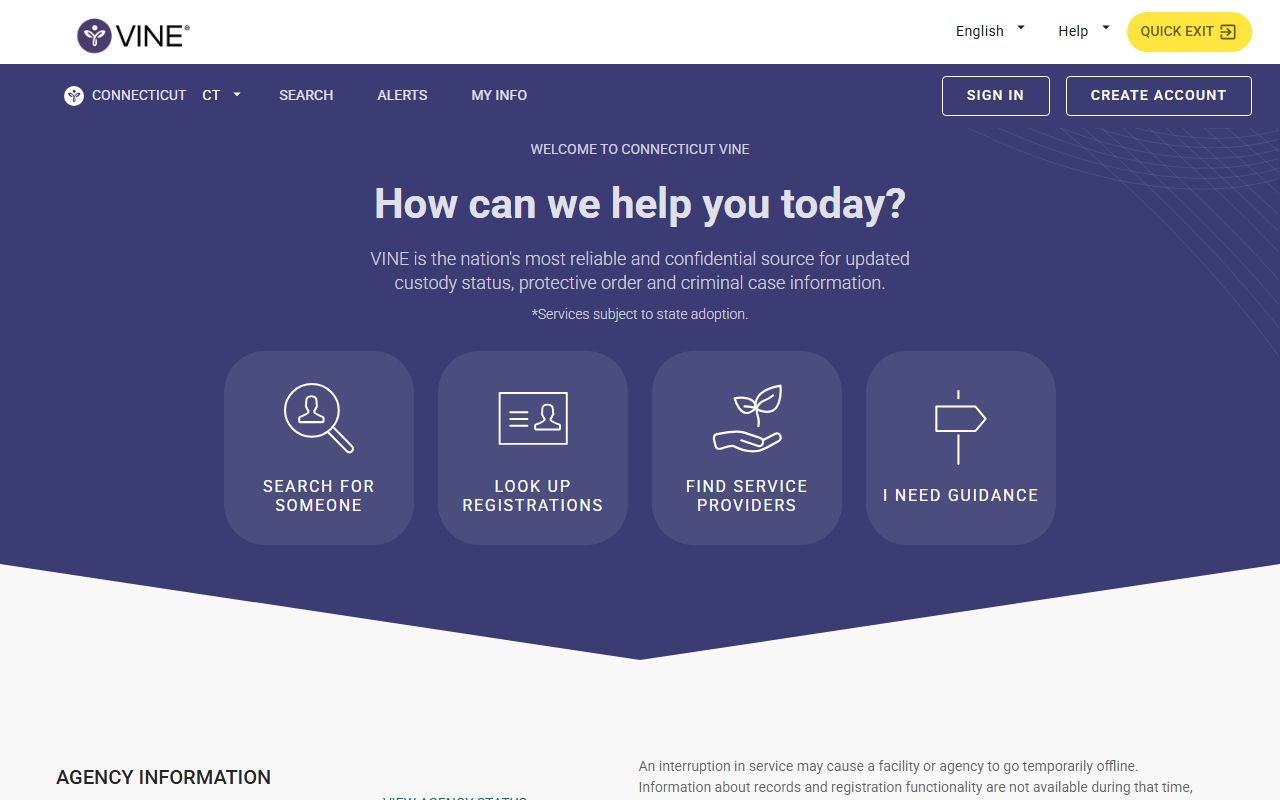
The state selection is essential. A federal case tied to Bridgeport requires the BOP locator instead.
Search a Bridgeport Inmate
Gather identity details before opening the service. CT SAVIN accepts a first and last name, inmate ID, or docket number. The extra identifier reduces the risk of following a person with a similar name.
- Open Connecticut in VINELink or use the CT SAVIN route from the Judicial Branch.
- Enter the full first and last name. Add the inmate ID or docket number when known.
- Open the matching custody record or court case and compare identifiers.
- If prison custody and a pending case both matter, register for each category separately.
- Read an alert as notice of a change, then confirm its legal detail with CT DOC or the court.
If no match appears, search the CT DOC inmate portal for the inmate number and current facility. A no-result is not proof of release. The person may have been in police-only custody, federal custody, another name, or a restricted record.
Bridgeport VINE Release Events
CT SAVIN defines notification events, but its brochure does not promise a complete release order, sentence calculation, booking photo, or criminal history. The alert tells the user that a source system reported a qualifying change.
| Alert field | What it establishes |
|---|---|
| Scheduled release | A planned prison release event |
| Released from prison | Departure from prison custody |
| Released to community | Community placement or release event |
| Released to parole | Out of prison under parole supervision |
| Transfer | Custody continued in another location |
| Court disposition | A reported case outcome, not a full judgment copy |
When exact time, terms, or reason matter, obtain the DOC discharge record, court order, or other source document. CT SAVIN is strongest for timely notice, not archival proof.
Register Bridgeport Release Alerts
Registration is available through VINELink, its app, the CT SAVIN line at 1-877-846-3428, the OVS Helpline at 1-800-822-8428, or the Judicial Branch CT SAVIN button. Users may choose app, phone, email, or text and may register multiple contacts.
- Find the correct person or case with a name, inmate number, or docket number.
- Select custody-status notifications, court-case notifications, or both.
- Choose each desired phone, text, email, or app channel.
- Create a four-digit PIN for phone and app confirmation.
- Update CT SAVIN if the registered contact information changes.
Phone calls are repeated until receipt is confirmed with the correct PIN under the schedule described in the state brochure. Email and text alerts are sent once. Never choose a PIN that another person can easily guess if notification privacy matters.
Bridgeport VINE Check Limits
VINELink is not the federal BOP locator and does not turn Bridgeport police records into a jail roster. A federal defendant appearing at the Bridgeport courthouse may be tracked through BOP and federal court records. A person released after brief police processing may appear only in the court or city record.
For older releases, use the court case or a focused DOC FOI request. The Bridgeport release-record search covers those longer-term routes. VINELink is designed around current matches and changes, not a complete history.
Note: “Released to parole” means prison custody ended while state supervision continued.
Bridgeport CT SAVIN Registration Layers
Connecticut’s notification layer is broader than a simple release call. State materials say notices are available in English, Polish, Portuguese, and Spanish. They cover DOC custody, court cases, and protection orders. This matters in Bridgeport because a bond change or disposition can explain why someone left custody even when no jail-release list exists.
Custody and court registrations are separate. If a person is in prison and also has a pending case, registering for one category does not automatically register the other. Complete both registrations when both event streams matter, and use the same clear identity details for each.
Protection-order notices are another distinct category. They should not be confused with inmate custody status. The alert text and registered category show which source event changed.
Confirm Bridgeport Release Alerts
After a release alert, check the DOC result for current status and facility. A facility still shown can indicate a delay or transfer. Next, review the court docket for bond, disposition, sentence, or violation activity. When a document is needed, request the nonexempt record from the office holding it.
CT SAVIN’s broad event list is useful, but each system remains authoritative for its own record. CT DOC controls state custody information, the Judicial Branch controls court records, BOP controls federal custody data, and Bridgeport police control city arrest records.
Read Bridgeport VINE Notifications
Every alert should be read by event type. “Scheduled to be released” reports a planned event and can change. “Released from prison” reports departure from prison custody. “Released to the community” and “released to parole” describe community status with different possible supervision terms. “Transferred” means custody continues in another place. Do not reduce all five labels to the word released.
CT SAVIN court notifications answer a separate question. A bail change, disposition, probation-violation notice, or sentence-reduction decision may explain a custody change, but the alert is not the full order. Use the docket number from the registration to locate the Judicial Branch case, then obtain the public order or judgment if exact conditions matter.
Phone notification requires the four-digit PIN to confirm receipt. State materials say calls repeat every 30 minutes until received. If the PIN is not entered, calls continue every two hours for up to 48 hours until the correct PIN is supplied. Text and email alerts are sent once. App notifications depend on the device and registration remaining active.
Use more than one contact route when a missed alert would matter, and keep each address or number current. CT SAVIN allows multiple phone numbers and email addresses. Do not share a registration PIN publicly. The PIN stops repeated calls and helps protect the privacy of the notification setup.
Language access is part of Connecticut’s distinctive system. The state materials describe service in English, Polish, Portuguese, and Spanish. The CT SAVIN line and OVS Helpline provide alternate entry points when the website or app is not workable. These channels still depend on a correct person or docket match.
Match Bridgeport VINE Sources
For a man held at Bridgeport CC, start with the CT DOC number and facility. For a Bridgeport woman in state custody, York Correctional Institution may be the relevant location. A younger male may be at Manson Youth Institution, subject to age, placement, and confidentiality limits. The statewide DOC and CT SAVIN routes remain more useful than a city jail search.
A person briefly held by Bridgeport police may never enter CT DOC. Search the court case and city records instead. A federal defendant connected with the Bridgeport courthouse belongs in the BOP locator and federal docket. VINELink’s Connecticut page should not be treated as a federal locator.
If the alert and DOC screen conflict, allow for processing time and ask the source agency. If a certified or detailed record is required, use DOC FOI or the court clerk. A status notification is valuable evidence of a change, but it is not a substitute for every underlying public document.
For an older event, identify a narrow date range and request release date, release type, facility, or discharge status. This creates a record trail after the live notification has passed. It also distinguishes actual release from a transfer alert or a scheduled event that changed.
Interpret Bridgeport VINE Matches
Multiple matches require caution. Compare the inmate ID, docket number, birth information where public, and facility. Do not register on name alone when the result offers a stronger identifier. Confirm any alias or spelling variation through CT DOC or the court.
Separate registrations provide two useful streams. Custody alerts can report transfer or prison release, while court alerts report bail, disposition, or violation action. Reading both often supplies more context than either alone, although they may arrive at different times.
Registration privacy matters. Keep the PIN and contact channels controlled, especially on a shared phone or email account. Update a changed number so repeated calls or messages do not reach the wrong recipient.
Never stretch an alert beyond its text. A hearing notice does not mean release was granted. Scheduled release can change. Transfer is not discharge. A disposition may not state the physical release time. Preserve the event label and verify missing detail with the controlling office.
CT SAVIN does not replace emergency services or direct court safety planning. It reports matched source-system events. If an alert appears inconsistent or urgent, confirm the record through the listed agency channel. For protection-order questions, use the court and victim-service contacts tied to that order rather than treating an inmate custody alert as the full legal status.
After release, keep the last alert with the matching DOC or court record. This makes the event easier to verify later, when VINELink may no longer function as a useful historical view.