
Bridgeport Correctional Center Release Paths
Connecticut Department of Correction identifies Bridgeport Correctional Center as a state level 4 facility for both pretrial and sentenced offenders. That mix matters. A pretrial defendant may leave after bond, a written promise to appear, nonfinancial conditions, or a court order. A sentenced person may complete a term, move to transitional supervision, receive parole, or discharge. A person can also leave Bridgeport Correctional Center through a transfer while remaining in CT DOC custody.
Transfer is not community release. The statewide inmate search may replace Bridgeport Correctional Center with another facility name, while CT SAVIN may send a transfer notice. By contrast, a result or notice that states released from prison, released to the community, or released to parole points to an actual change out of prison custody. Court records can explain a bond change, dismissal, nolle, sentence, or other order behind a pretrial release.
Bridgeport Correctional Center Record Checks
The public information route depends on what needs confirmation. CT DOC Public Information accepts questions about incarcerated people at (860) 692-7780 from Monday through Friday, 8:00 a.m. to 4:30 p.m. Its mailing address is 24 Wolcott Hill Road, Wethersfield, CT 06109. That office addresses current public inmate information. The FOI office is the better route when the need is a copy of a nonexempt record or documented past discharge.
A parole hearing calendar is another limited tool. The Connecticut Board of Pardons and Paroles publishes changing hearing schedules for parole, revocation, and early termination matters. It is a calendar, not a person-name archive, and eligibility does not guarantee release. A past Bridgeport Correctional Center release to parole is better supported by the CT DOC event, a CT SAVIN notice, a public BOPP record when available, and a focused FOI response.
Pretrial cases require a different reading. A person held at Bridgeport Correctional Center may have no sentence to discharge. Promise-to-appear terms, nonfinancial conditions, and bond decisions arise from the court and Court Support Services Division process. The inmate search can show that custody changed, but the docket is more likely to explain the legal basis. This keeps a pretrial bond release separate from parole, earned-credit calculations, and completion of a prison term.
A release record should be checked against the facility and date. Bridgeport Correctional Center serves several superior courts, so a same-name court case from another location can still relate to this facility. The CT DOC number, birth details, admission date, and docket narrow the match. When sources disagree, request the agency record rather than choosing the result that appears most recent.
Confirm a Bridgeport Correctional Center Release
The CT DOC inmate information search is the first public route for a person held at Bridgeport Correctional Center. It accepts a CT DOC number or identifying details. The number is the strongest key because names can match. The result should be read for status, current facility, and any release or projected release date. A listed institution usually indicates custody or transfer, not a completed release.
- Search the CT DOC number when it is known.
- Otherwise enter last name, first name, and date of birth.
- Read status and facility before relying on a date.
- Compare the event with Connecticut VINELink and the court case.
- Check BOPP material if the event involved parole.
- Request the public discharge record if online results remain unclear.
CT SAVIN is useful for recent change events, including scheduled release, release from prison, release to the community, release to parole, and transfer. It is not a complete historical archive. A court docket may remain available after a short stay ends and can show why the person left. For a broader explanation of these channels, the Bridgeport release search and records coverage separates state, police, court, and federal custody.
The discharging location also controls the first practical follow-up. A transfer before discharge means the receiving CT DOC institution may hold the final release record and identification, even when the person spent most of the custody period at Bridgeport Correctional Center.
Note: A projected date can change, so it should not be treated as proof that a Bridgeport Correctional Center release occurred.
Bridgeport Correctional Center Release Records
The facility can confirm its identity and direct an operational question, but a formal public release or discharge record belongs with CT DOC Freedom of Information. A narrow request should give the full name, date of birth if known, CT DOC number if known, Bridgeport Correctional Center, an approximate custody range, and the specific fields sought. Useful fields include admission date, custody status, release or discharge date, release type, and releasing facility.
Bridgeport Correctional Center
1106 North Avenue
Bridgeport, CT 06604
Phone: (475) 225-8000
Fax: (475) 225-8050
CT DOC Freedom of Information
24 Wolcott Hill Road
Wethersfield, CT 06109
Phone: (860) 692-6290
Fax: (860) 692-7873
The DOC FOI office coordinates requests under Connecticut public-records law. A request can ask for records sufficient to show the admission, status, date, type, and facility tied to the release. Medical, security, victim, juvenile, sealed, and erased material may be withheld. Asking only for the nonexempt release facts is more precise than seeking an entire institutional file.
Bridgeport Correctional Center Custody Records
Bridgeport Correctional Center serves more than the city itself. CT DOC says it serves superior courts in Ansonia, Derby, Milford, Bridgeport, Danbury, Norwalk, and Stamford. A person housed there therefore does not necessarily have a Bridgeport arrest or Bridgeport court case. The center also manages a level 2 minimum-security sentenced workforce unit for people who qualify for outside-clearance community support assignments.
This structure explains why no Fairfield County sheriff roster should be used as a substitute. Connecticut operates a unified state correctional system. Bridgeport police arrest papers, a Superior Court docket, the CT DOC inmate record, and a BOPP parole record are separate sources that can describe different parts of one case. Reconcile the name, birth information, DOC number, docket, facility, and date before concluding that two records concern the same person.
- Pretrial
- Held while a criminal case is pending, without a sentence discharge date.
- Discharge
- Completion of the correctional custody portion recorded by CT DOC.
- Parole
- Community release under the Connecticut Board of Pardons and Paroles.
- Transfer
- A move to another placement while custody continues.
Bridgeport Correctional Center Release History
Facility history helps explain why records may refer to different buildings or units at the same North Avenue site. CT DOC says Bridgeport Correctional Center opened in 1958. The New Center was built in 1974 for about 310 level 4 inmates. The oldest portion was later demolished in 1997 after fire damage in 1990 could not be repaired. Madison, Fairmount, and Memorial are open-dorm residential units built in 1986 and 1992.
The official Bridgeport Correctional Center page is shown in the captured view below.
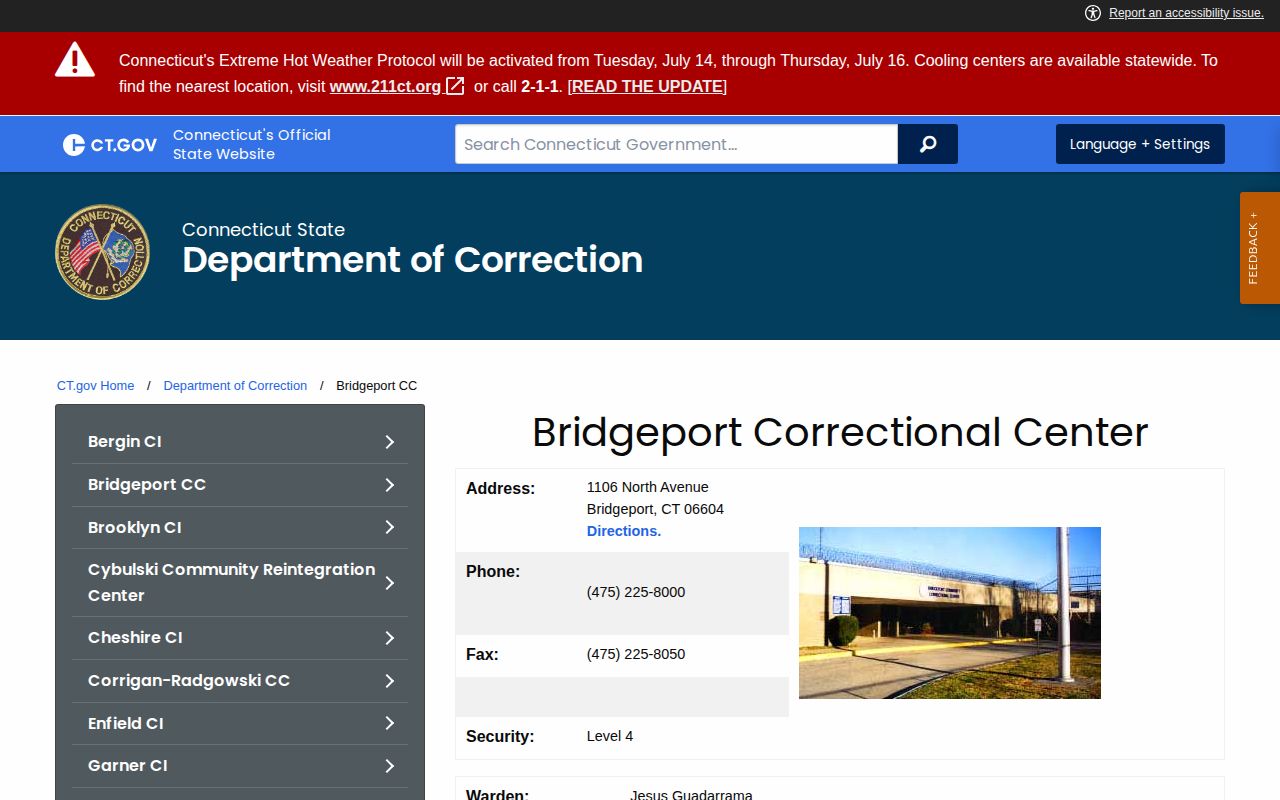
The state page anchors the facility name, custody type, contact details, court service area, and building history used to interpret a Bridgeport release record.
The history belongs to Bridgeport Correctional Center alone. It should not be used to infer that York, Manson, the police department, or the federal courthouse shared the same opening dates or building plan. Those sites have different roles and separate record routes.
After a Bridgeport Correctional Center Release
A direct community release may still carry court conditions, transitional supervision, probation, or parole. CT SAVIN can describe a custody event, while BOPP sources address parole eligibility and hearings. Neither source turns a transfer into a release. If the inmate search still lists a CT DOC institution, custody likely continues even when the person has left North Avenue.
Identification held apart from other property remains at the discharging facility until discharge. CT DOC Offender Re-Entry Services states that unclaimed identification stays at that facility for 30 days, then moves to DOC Central Office and may be kept for up to two years after discharge. This is a practical reason to identify the actual discharging facility rather than assume Bridgeport Correctional Center kept the item after a transfer.
For an old or disputed release, preserve the source and access date. Online status can change. A CT DOC FOI response supplies a more stable agency record, and the court file may supply the legal event. Together they distinguish bond release, sentence discharge, parole, and an internal transfer without forcing every event into the label of a county jail release.
Note: Bridgeport Correctional Center is state operated, so CT DOC records control even when the related arrest occurred within the city.