
Bridgeport Parole and Probation
Parole follows a prison sentence and permits an eligible, suitable person to serve part of that sentence in the community. The Connecticut Board of Pardons and Paroles, or BOPP, decides parole for eligible state prisoners. Probation is imposed by a court, often as part of a sentence, and is administered through the Connecticut Judicial Branch Court Support Services Division. A Bridgeport resident can therefore be out of Bridgeport Correctional Center yet remain subject to either system.
Pretrial release is different again. A person who posts bond or signs a promise to appear has not been paroled or discharged from a sentence. Court conditions may still apply while the criminal case remains pending. The source and timing of release determine which record to check.
| Status | Who controls it | Best verification |
|---|---|---|
| Parole | BOPP and CT DOC | DOC status, BOPP record, CT SAVIN |
| Probation | Judicial Branch CSSD | Court docket and probation contact |
| Pretrial release | Court or bail official | Current court docket and release order |
- Parole
- Conditional community release before the full prison sentence ends.
- Probation
- Court-ordered supervision in the community.
- Discharge
- The formal end of custody or supervision.
- Absconder
- A supervised person alleged to have stopped reporting or left supervision without approval.
Verify Bridgeport Release Supervision
Begin with the custody type, not the person’s absence from a roster. Bridgeport Correctional Center is run by CT DOC, so state custody and state sentence records control its release trail. The public CT DOC inmate information search can show current facility, status, and public release information. It does not cover someone released from brief Bridgeport police custody without DOC commitment.
- Search CT DOC by inmate number when known, or by name and date of birth.
- Read status and facility first. A new facility means transfer, not community release.
- For parole, compare DOC status with BOPP eligibility and hearing material.
- For probation, search the Judicial Branch case for the sentence and later violation events.
- Use CT SAVIN for custody changes and court alerts, then request the source record if exact terms matter.
A missing result does not prove that supervision ended. Sealed or erased records, data lag, a name variation, federal custody, and a police-only release can all produce an incomplete online trail. An official discharge record is stronger than an inference from silence.
Bridgeport Supervision Record Sources
There is no single Bridgeport supervision roster. BOPP publishes parole eligibility rules and a changing hearing calendar, while CSSD and the court case provide the probation and pretrial path. CT SAVIN adds notice of parole hearings, release to parole, probation-violation notices, and probation-violation decisions. Each channel has a defined role.
Parole eligibility and hearing records
Current hearing calendar
BOPPFOI@ct.gov for official hearing recordings
The BOPP calendar is date-driven, not a complete name-searchable results archive. Hearings generally begin at the posted time and are streamed through links on the schedule. A listed hearing does not mean parole was granted. The final docket or requested recording must be read for the outcome.
Bridgeport Violations and Warrants
Supervision conditions vary by the court order or parole terms. Common categories can include reporting, travel or place limits, treatment or program participation, and compliance with laws. An alleged breach can lead to a probation-violation case, a parole revocation process, a warrant, or return to custody. The word absconder signals an alleged failure to remain in contact with supervision, not proof that a new crime occurred.
CT SAVIN materials list probation-violation notices and decisions among court alerts. They also list parole hearings and release to parole among custody events. For a precise result, compare the alert with the court docket, CT DOC status, or BOPP record. A person can be out of one facility and held elsewhere on a warrant or detainer.
Bridgeport Supervision Discharge Records
Supervision ends through an official action, not merely because a public page stops displaying a person. Probation can end when the court-ordered term expires or the court enters an authorized change. Parole or special parole ends under the governing sentence and agency record. A DOC discharge record, court docket entry, or BOPP record provides the best proof.
If the public search lacks enough detail, request nonexempt records from CT DOC or the court clerk. Include the legal name, DOC number if known, docket number, facility, and approximate dates. The broader Bridgeport released-inmate search explains how court, DOC, notification, and records-request sources fit together.
Note: Eligibility for parole only allows Board consideration; it never guarantees that release or supervision will begin.
Bridgeport Reentry After Release
Bridgeport adds a local layer after state custody. The city’s Mayor’s Initiative for Reentry Affairs lists case management, legal aid, mentoring, internships, volunteer opportunities, and links to local and statewide partners. These services help a person navigate return to the community. They do not decide parole, probation, or legal eligibility.
The source page below shows the city’s reentry support route.
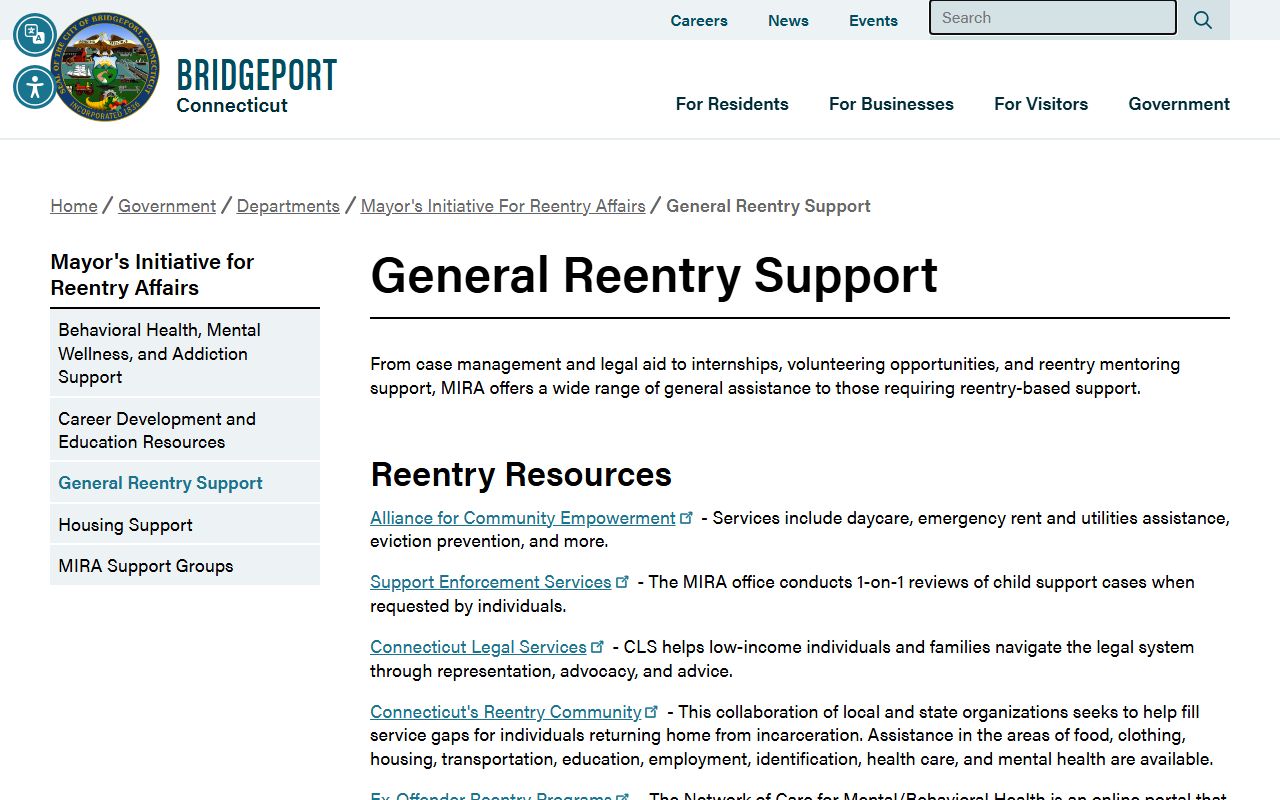
That local help can complement the formal requirements set by BOPP, CT DOC, or CSSD, but the supervising authority remains the source for binding conditions.
Bridgeport Release ID Retrieval
CT DOC keeps identification documents admitted with an offender at the facility until discharge. If the person does not claim them, the Offender Re-Entry Services page says the documents remain at the discharging facility for 30 days, then move to DOC Central Office for up to two years after discharge.
The listed contacts are 860-692-6836, 860-692-7869, and DOC.ORSU@ct.gov. This is a property-retrieval rule, not evidence of current parole or probation. Still, recovering identification can be a key first task after a Bridgeport release.
Bridgeport Pretrial Supervision Distinction
Connecticut law separates release before trial from post-sentence supervision. Under section 54-63d, a bail commissioner or intake specialist may order a promise to appear, nonfinancial conditions, or a bond when the statutory criteria are met. Section 54-63b assigns CSSD duties that include interviews, court reports, appearance notices, and supervision directed by the court.
That person is not on parole simply because custody ended. Check the court order for pretrial terms. Use BOPP and CT DOC only when a state sentence or parole status is involved.
Bridgeport Parole Hearing Records
BOPP’s public hearings page is a live calendar rather than a complete archive. It includes parole, revocation, early-termination, and pardon-related dockets with date-specific video links. The page says hearings usually start at 9 a.m. unless another time is posted, and that proceedings are held virtually. Because links and dates change, save the docket information needed to identify the matter.
A scheduled hearing only proves that a proceeding was placed on the calendar. It does not establish that parole was granted or that a release date was fixed. Possible outcomes include grant, denial, continuance, rescission, revocation, or another action stated in the official record. BOPP distinguishes eligibility from suitability: the law may permit review, while the Board must still decide whether release is suitable.
The official hearing recording can be requested through BOPP FOI. Its hearings page warns that the public may not make a separate recording of the livestream under the cited Connecticut rule. Ask for the recording or docket by date and proceeding type rather than treating a remembered livestream as the record.
CT SAVIN can send a parole-hearing or release-to-parole notice. Compare that notice with the DOC custody status and BOPP result. If CT DOC still lists a facility, the public record may not yet reflect release, or the event may have concerned eligibility rather than departure. If status reads release to parole, supervision continues in the community until formal discharge or another authorized end.
Probation uses a different trail. The Judicial Branch docket can show the sentence, a violation notice, a violation decision, and later court action. A parole calendar will not verify a probation term. Likewise, a probation docket does not certify a BOPP parole outcome. Matching each status to the office that controls it prevents the most common Bridgeport supervision error.
Bridgeport Supervision Record Checks
Pretrial supervision must remain separate from parole. Sections 54-63b and 54-63d describe CSSD duties and forms of release before trial, including a promise to appear, nonfinancial conditions, and bond. Those terms govern a pending case. They do not show that a prison sentence was discharged.
When a record is incomplete, use a narrow request. For parole, identify the person, DOC number, hearing date, and docket type. For probation, identify the court, docket number, sentence date, and public entry sought. Avoid unrelated medical, victim, juvenile, sealed, or security information.
A warrant or alleged absconder status also requires a current source. A later return to custody, violation decision, or discharge can change the record. CT SAVIN helps identify events, while the court or supervising agency supplies the controlling result.
Bridgeport reentry support does not replace supervision. MIRA and community partners can help with case management, legal aid, mentoring, and practical needs, while BOPP, CT DOC, CSSD, and the court retain authority over legal conditions. A service provider cannot change a reporting rule or certify discharge. The person should keep the supervising office informed and use the official record for status.